Pages

Sunday, 29 May 2016

First Annual Family Math Night

On Thursday May 5th, our school hosted our First Annual Family Math Night!
Moraine Hills Public School in York Region District School Board


Family Math Night is "a fun, shared experience that promotes family involvement with math, build strong family-school partnerships, create a sense of community, and connect family engagement to student learning" (Family Math Night, 2016).

Our school had a team of educators from each division come together to plan and co-facilitate this wonderful learning opportunity. I was very fortunate to be one of the co-faciliators!


When planning for this event, Family Math Night supplied us with kits to get us started. Some items include:
  • "8 leveled stations with a total of 24 standards-based activities
  • All the materials and manipulatives for 120 K-5 students and their families
  • Marketing tools such as customizable flyers, announcements, and sample letters
  • Video tutorials and reference guides so anyone can set up your event
  • Meets Title I Section 1118 Parent Participation Requirements"
(Family Math Night, 2016).

Each of the activities are designed around sound mathematical principles and were developed by a veteran elementary school teacher with over 25 years of classroom experience. Each of the activities are also aligned with the Core Curriculum Standards (Family Math Night, 2016).

For our Family Math Night we utilized some of the main ideas but compiled our own activities that we were using in the classroom with our students. We chose to do this so that the concepts being taught in class would be reinforced with the students and their families during the Family Math Night. We also tried our best to ensure that there was one activity for each of the 5 strands in the Mathematics Curriculum which include: Patterning, Geometry, Number Sense & Numeration, Data Management, and Measurement


Connection to the Ontario Curriculum in Mathematics Grades 1-8 (2005):


  • Importance of Mathematics"An information- and technology-based society requires individuals who are able to think critically about complex issues, analyst and adapt to new situations, solve problems of various kinds, and communicate their thinking effectively. The study of mathematics equips students with knowledge, skills, and habits of mind that are essential for successful and rewarding participation in such a society"
  • Roles and Responsibilities of Parents "studies show that students perform better in school if their parents or guardians are involved in their education"
  • Roles and Responsibilities of Teachers "responsible for developing appropriate instructional strategies to help students achieve the curriculum expectations, and for developing appropriate methods for assessing and evaluating student learning"
  • Roles and Responsibilities of Students "willingness to engage in activities, reflect on their experiences, learn and apply strategies and processes that promote understanding of concepts, and to pursue opportunities outside of the classroom to extend and enrich their understanding of mathematics"
Personal Reflection

I feel that when schools host an Annual Family Math Night it allows for parents to be involved in their child's education, it allows students to engage, reflect, and apply their knowledge outside of the classroom, and it allows the teachers to continue to plan, facilitate, and reinforce learning within different settings. These Family Math Nights hold such importance because it proves that learning does not only have to occur during school hours and only at school, rather it can be continued at home as well. Each of the stations we have facilitated allowed some form of a take-home kit so that the parents and their children can continue to practice the skills and concepts at home. 


Math was never my strong subject as a child or a teenager so I always became disengaged whenever I was unsuccessful. As a teacher I am always trying to find new ways for teaching math that meet the needs, interests, and abilities of my students so that they can be successful and LOVE MATH! I am always connecting math to real life experiences and provide plenty of hands on exploration, manipulatives, and technology to support learning experiences. I also take advantage of every opportunity I have to further my knowledge base in the area of mathematics through: professional development workshops and Additional Qualification courses. As a teacher I can say that I LOVE MATH and from what I have been hearing from my students, they too LOVE MATH! :) I will continue to co-facilitate Family Math Nights within any school community I am part of!


For additional information on the set-up, obtaining Family Math Night Kits and resources, and parent handouts to support child learning at home please visit: http://www.familymathnight.com/resources/familymathnight.php 


Wednesday, 27 April 2016

Cross-Curricular Learning with the Chrysanthos Colour Wheel

I have recently learned about the Chrysanthos Colour Wheel which was created by "curving the wedges of a traditional color wheel to create what has been dubbed a Trigeod. The Trigeod shapes are then rearranged to form another variation of the color wheel named the “Chrysanthos color wheel”. The color wheel is comprised of twelve Trigeod shapes which are painted in the twelve colors of the color wheel.
The Trigeod is so versatile, that the slogan “One Shape, Many Minds, Infinite Possibilities™” has been coined to describe it" (Chrysanthos Colour).


Upon discovering this colour wheel on Instagram at ChrysanthosColor, I immediately found it to be a great teaching manipulative within all curriculum areas. It’s colourful pieces attract the eye of the students and I loved how open-ended of a product it was. You can use it for anything!

First, I set up an introductory activity for my students and allowed them to create freely with the colour wheel. I wanted to see if there was an interest before proceeding with further lessons.


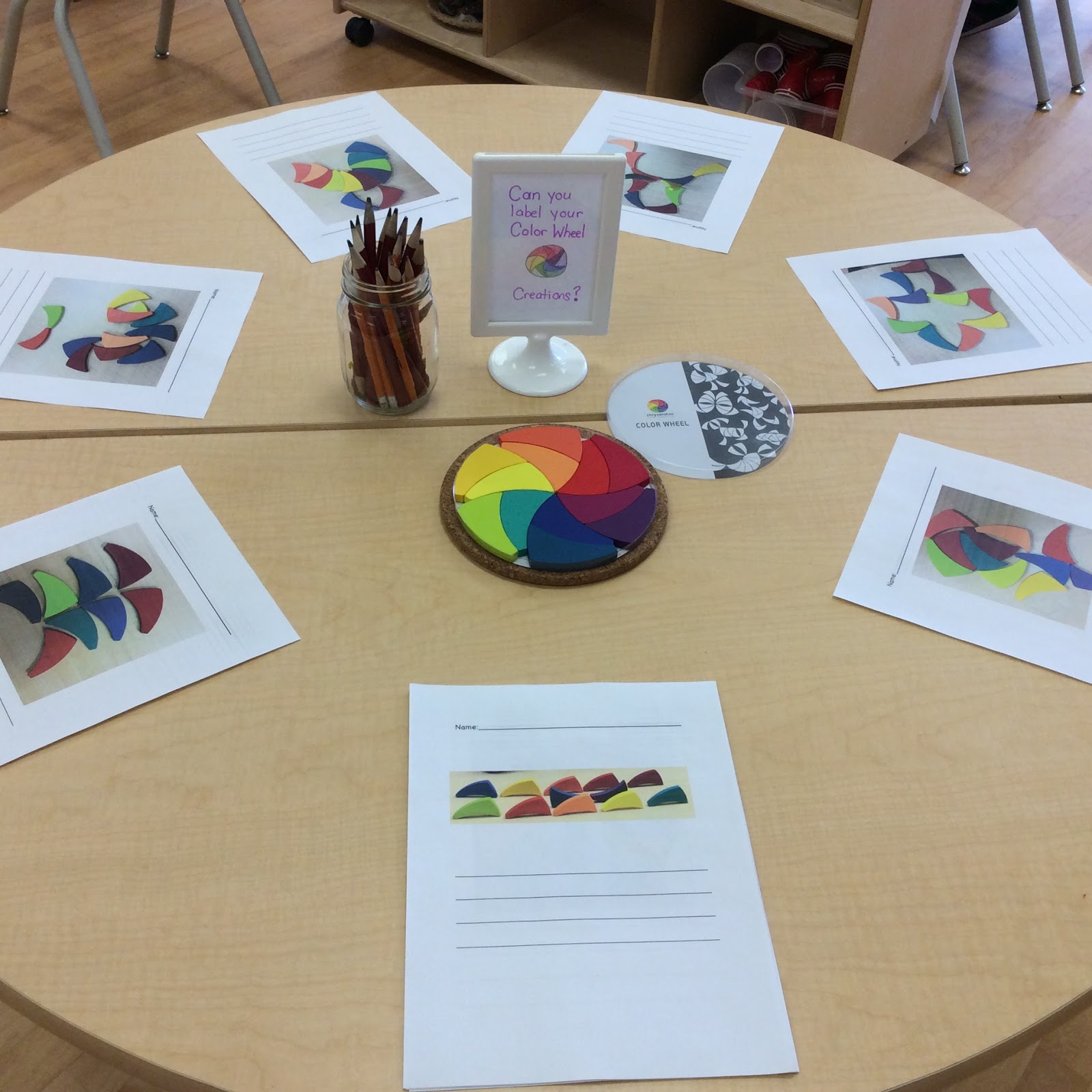
 Colour Wheel Creations Provocation


From this activity I realized that my students were actively engaged and the colour wheel has indeed sparked an interest for them, a high interest level. When looking at some of their creations I noticed that some of them created shapes and patterns, which led me to creating some mathematics provocations later on.

Cross-Curricular Connections

Heath: H4.1 Begin to demonstrate control of small muscles in activities at a variety of learning centres and when using a variety of materials or equipment
Visual Arts: V2.2 Explore different Elements of Design in Visual Arts
Mathematics (Geometry): G3.1 Explore, sort, and compare traditional and non-traditional 2-D shapes and 3-D figures
Drama: D1.2 Explore a variety of tools and materials of their choice to create drama and dance in familiar and new way (possible extension could be that the students act out what they have created i.e. pretend to be a shark or jellyfish)
Following this provocation, I printed off the pictures I had taken of their creations and incorporated a writing component: Can you label your colour wheel creation?


L4.3 Write simple messages 
L4.4 Begin to use classroom resources to support their writing


The students were all interested in discovering what it was, what its made of, and what they can create with it. The possibilities really were endless. Due to the high interest level and engagement level, I decided to create a series of lesson plans which showcase the many ways the Chrysanthos Colour Wheel can be used in a Full-Day Kindergarten classroom. See examples below:

Colour Wheel Scavenger Hunt Provocation 

 The students had the opportunity to find items within our classroom environment that match the colours they see in the colour wheel. The book that went nicely with this provocation was called "Counting Colors."


The students were able to find a variety of classroom items and place them where they corresponded with the colour wheel colours!


Cross-Curricular Connections

Visual Arts: V2.2 Explore different Elements of Design in Visual Arts
Mathematics: DM5.1 Sort, classify, and compare objects and describe the attributes used


Colour Wheel Experiment Provocation

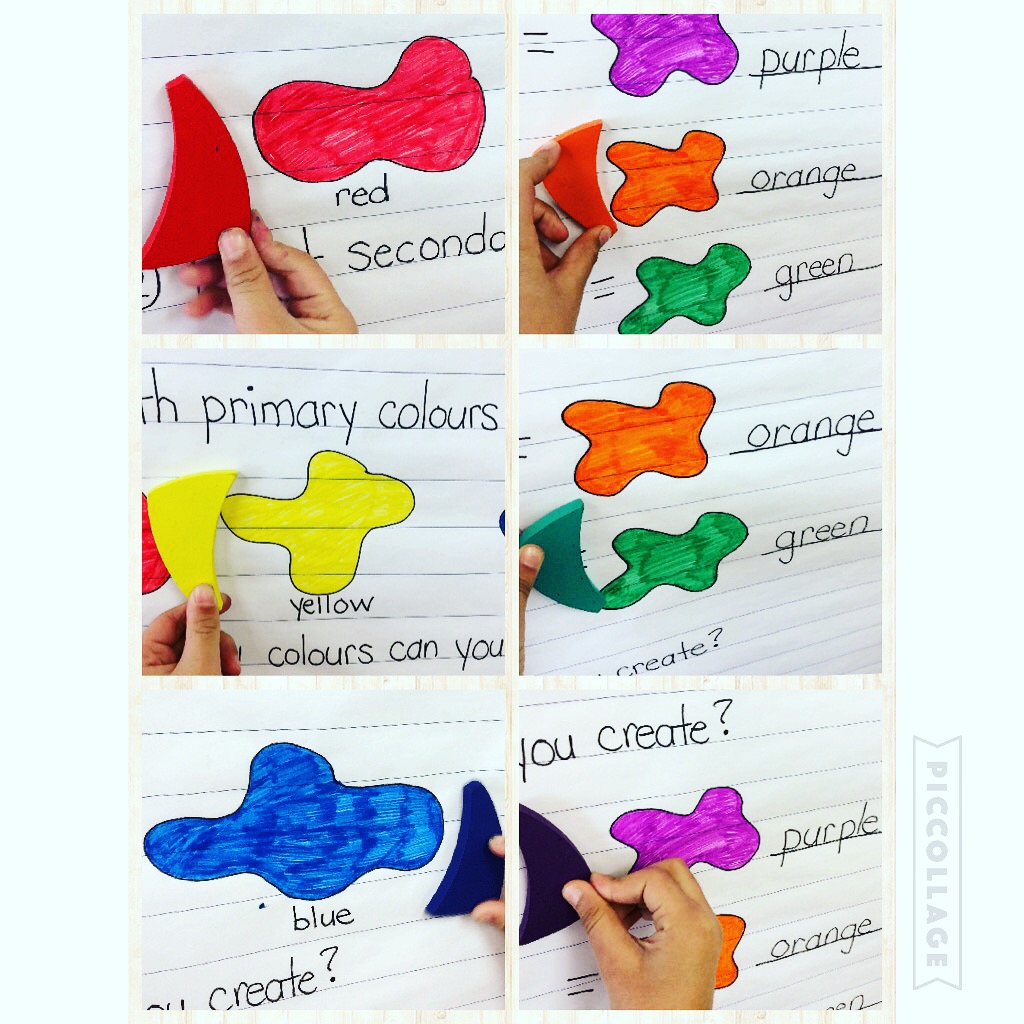
The students had the opportunity to mix primary colours together to see which colours can be created. I first read the story "Mix It Up!" which gave them an understanding of which colour combinations can be created.  They also had lots of fun creating their own colours.


The students and I then co-created an anchor chart which was placed on display in the art centre. During a later provocation, this anchor chart was revisited when a student asked me which colours make green. We paid a visit to the chart and the student was able to see that yellow + blue made green.


The students then used the colour wheel puzzle pieces to match the colours on the anchor chart.


Cross-Curricular Connections

Visual Arts: V2.2 Explore different Elements of Design in Visual Arts
Science & Technology: 2.2 make predictions and observations before and during investigations
Science & Technology: 2.4 communicate results and findings from individual and group investigations
Mathematics: DM5.1 Sort, classify, and compare objects and describe the attributes used


Number & Alphabet Creations


The students were able to practice their alphabet and numbers 1-10 using the Colour Wheel Puzzle pieces and Reading Rocks. 


Two books that went really well this provocation were: "Numbers Everywhere" and "Alphabet Everywhere" which showed beautifully how letters and numbers can be seen in our everyday environment.


An extension to the number creations provocation was representing numbers using the colour wheel and the reading rocks.


Cross-Curricular Connections

Mathematics (Number Sense): NS1.7 Demonstrate an understanding of number relationships for numbers 0 to 10, through investigation
Mathematics (Number Sense): NS1.9 Use, read, and represent whole numbers to 10 in a variety of meaningful contexts
Language: L2.8 Demonstrate knowledge of most letters of the alphabet in different contexts
Health: H4.1 Begin to demonstrate control of small muscles in a variety of learning centres and when using a variety of materials or equipment
Sorting in HPE

I first read the book "Sorting" and then we went to the gym and the students had the opportunity to run and sort the colour wheel pieces by colour. While waiting for their turn they participated in a game of Simon Says Fitness: Stretches/movement skills (run, jump, throw, kick, skip, jog on spot, squat, etc.)
Cross-Curricular Connections
Visual Arts: V2.2 Explore different Elements of Design in Visual Arts
Mathematics (Data Management): DM5.1 Sort, classify, and compare objects and describe the attributes used
Heath and Physical Education 2.1 Participate actively in creative movement and other daily physical activities
Addition and Subtraction Provocation

The students had the opportunity to add and subtract using the colour wheel pieces. Two books that went really well with this provocation were "If you were a plus sign" and "If you were a minus sign". The wooden frames were great for teaching this because the students can visually see that when you add you put more inside the frame and when you subtract you take it out of the frame and put it on the outside.

Mathematics Curriculum Connections
NS1.3 Begin to make one-to-one correspondence in counting objects and matching groups of objects and matching groups of objects
NS1.5 Recognize some quantities without having to count, using a variety of tools or strategies
NS1.12 Investigate addition and subtraction in everyday activities through the use of manipulative or oral communication
Bulletin board display in our classroom. #makinglearningvisible

Overall, I feel that the Chrysanthos Colour Wheel is a great open-ended teaching and learning manipulative and I highly recommend it for all educators to use with their students. I have only showcased a selection of lesson ideas to use but there are many more!
Should you wish to purchase your own colour wheel to use in your classroom please visit: Chrysanthos Colour 
*Class sets are also available


Remember to stay connected with my Instagram account to see more play & inquiry based teaching and learning opportunities: @educate.invest.inspire 

With teaching and learning, the possibilities are endless!

Monday, 28 March 2016

Technology in the Classroom

As a recent graduate from the University of Ontario Institute of Technology (UOIT), I would say that technology is used in my classroom on a daily basis. Below is a working list of some technology and how my teaching partner Trista Dutt and I use them in our classroom:

  • SMART Board: morning message, DPA (gonoodle.com), learning collages (reflecting on what was learned/what students wish to learn, YouTube, read-aloud stories, educational games, transitions
  • IPad: documenting students learning through photos/video/audio/pic collages/google docs, educational games such as letter tracing, allowing the students to document their own learning and voice, sharing documentation with staff, admin, parents, and other educators through our social media accounts (IG: Educate.Invest.Inspire IG: KindieKorner P: educate.invest.inspire P: Trista Dutt) 
  • Laptops/Computers: to print off lesson plans, instructions for experiments, checking e-mails (parent/staff/admin communication), educational games and websites for students to access, research for teachers and students, collaborating and creating lesson plans, writing blogs
  • Cell Phones: often used when IPads have run out of battery and are charging back up
  • Document Camera: Our Tech Lead has recently asked if we could put one of these to use, to which we responded most definitely! In our FDK class we could use these for projecting our storybooks during our daily read alouds, presenting any work or small items so everyone can see it, and much more!

Over the 6 years of my educational career and work experience with children, I have compiled a variety of web-based resources and APPs which assist me in providing the best innovative educational programs and learning opportunities to meet the needs of all students. 

I have included a list of resources that my ICT professor Laura Morrison curated for us at UOIT:

Movie Making Programs

  • Movie Maker
  • iMovie
  • Animoto
  • PopcornMaker

Storymaking Programs:
  • Comic Life
  • Comic Master
  • iBooks 
  • Storybird

Digital Poster Making Tools:


  • Glogster
  • Tackk
  • Smore
  • Thinglink
  • Canva

Curation Tools:
  • Evernote
  • Mindmeister
  • Diigo
  • Storify
  • Symbaloo
  • Pinterest

Accommodation Tools:
  • Dragon
  • SmartIDEAS
  • VoiceThread
  • Word Q

Collaborative Brainstorming Tools:


  • Mindmeister
  • Popplet 
  • Linoit
  • Padlet

Feedback/Tutorial Tools:

  • Screencast-o-matic
  • GoodNotes

Online Learning Tools:

  • Desire2Learn
  • GoogleSites
  • Weebly
  • Wix
  • Wikispaces

Social Media Tools:


  • Google Hangouts
  • Facebook
  • Instagram
  • Tumblr
  • Vine
  • Twitter
  • Edmodo
  • Ning
  • Celly

Math Tools:
  • ixl.com
  • funbrain.com
  • link to learning
  • nlvm.com 

Another great resource that I have recently found out about is EducatorsLog which is an “app that has been specifically designed by teachers for teachers to help them meet classroom expectations. EducatorsLog provides fast and efficient methods for documenting student learning for all grades including full day kindergarten” (Spence). 


Should you wish to learn more about this you may visit: www.educatorsLog.com.
I look forward to trying this APP within my classroom!

I have recently completed my Mathematics Pt.1 AQ, ESL Pt.1 AQ, Reading Pt.1 AQ, and Health and Physical Education ABQ where I have received and curated a variety of web-based resources and APPs that are specific to Mathematics, ESL, Reading, and Health and Physical Education. Should you wish to obtain some of these subject specific resources, you may leave a comment or e-mail me at educate.invest.inspire@gmail.com  

I feel that educators are always learning and growing as individuals and as professionals. To further my professional development and knowledge base in Technology I will be attending an EdTech Camp Conference which is hosted by York Region District School Board on April 9th, 2016. This conference will allow educators to gain practical insights into how to use Google Apps for education and other technology tools and resources in their school in with their students. I feel that this conference will strengthen my technological skills within a classroom setting. Thank you to Trista Dutt for informing me of this wonderful learning opportunity!

I would like to leave you with this quote:


Technology in the classroom allows us to better prepare students for the future. Teaching content, methods, criteria, are constantly changing and adapting to meet the needs, interests, abilities, and future career paths for our students. We cannot teach our students today how we were taught in prior generations because there has been so many advancements in technology, in content, in methods/strategies. All children are capable, competent, and creative and we need to provide them with the resources for them to be able to express that.

If you have any additional resources you would like to share with me, please do as I enjoy learning about new technology!


Tuesday, 1 March 2016

Fostering an Inclusive and Respectful Learning Community

As an Educator I foster an inclusive and respectful learning community where everyone feels safe and valued by maintaining positive relationships and infusing TRIBES in my classroom. “The TRIBES process not only establishes a caring environment for cooperative learning, but provides structure for positive interaction and community for working groups whether in the classroom, the faculty, the administration, or the parent community” (Gibbs, 2006, p. 9).

The 4 pillars of TRIBES are:
  1. Mutual Respect
  2. Attentive Listening
  3. Appreciations/ No Put-downs
  4. Right to pass/participate


**Research shows that bullying is decreased by 80% when TRIBES is implemented in schools and becomes a whole-school initiative.

The 4 pillars can be infused within any grade level. I have previously implemented it through the co-creation of a teach chart (looks like/sounds like/feels like) at the beginning of the year and referred to it throughout the year for consistency and to build community. The 4 pillars are our classroom agreements which all staff and students strive to uphold.


Currently, I have created TRIBES Transition sticks where both myself and my teaching partner Trista Dutt implement TRIBES activities during transitions and in community circle. 


Some examples of the TRIBES activities are: 
  • Something good (each child shares something good that happened to them either that day, week, or year)
  • Do after me (a repeat after me game where the leader chooses an action and the players follow suit, kind of like Simon Says)
  • Wishful thinking (each student shares something positive they want to happen in their lives i.e. to go to the park on the weekend with mom or dad)
An abundance of activities can be found in the book, a sample of what one looks like/entails is shown below:


During the day, there is always opportunity for each of these groupings to take place in our classroom. Large group teachings or gatherings usually takes place within a community circle (children are seated in a circle formation around the carpet). This circle is to represent how the First Nations/Inuit/Metis Peoples sat in a circle for their traditional storytelling/teachings.

Through my Restorative Practice Framework and Circle Training workshop, I learned that it is important to foster a respectful, inclusive community where each individual feels valued and included right from the start. The students also need to be comfortable amongst their peers prior to engaging in community circle because those who feel uncomfortable or those who are bullied will not want to share openly and freely in the group. As an educator it is up to us to create a positive atmosphere from day 1 and have the children collaboratively working together with a growth mindset so that the 4 main pillars of TRIBES can be reflected in our classroom community and community circle can be effectively implemented.

My goal as a teacher in the 21st century is to create a student-centred classroom. Opposing research proves that “when classrooms are re-organized into student learning groups, ‘teacher talk’ time lessens from 70% to 25% and that 75% of the teachers time can be spent in praising, encouraging initiatives, giving feedback, facilitating student communication, and helping students” (Gibbs, 2006, p. 51-52). Student learning groups are when the desks are arranged into several smaller groups with 4-5 students per group as seen below:


This classroom arrangement fosters active engagement, positive behaviours, collaboration, inquiry, and an inclusive environment. The blue circle represents the teacher who circles around the room and provides encouragement and assistance as needed and the white circles represents the students that are seated in small groups/"tribes" within a community.


Last Summer, prior to commencing the Bachelor of Education program at UOIT the option of attending a TRIBES Learning Community workshop was provided to us. Even though it was presented as optional, I decided to attend because it was advertised that they would provide us with insight on new teaching and learning strategies. Also, I have never been known to turn down a great learning opportunity…and what a great learning opportunity that was! :) That summer I was officially TRIBES trained and I have to say that I infuse TRIBES into my teaching practice on a daily basis for:
  • Attention grabbing strategies
  • Appreciations
  • Energizers
  • Behaviour guidance
  • Teaching strategies
  • Learning Opportunities
  • Most Importantly: Community Building which is fostered through the aforementioned points 
I would highly recommend all educators to obtain their TRIBES Certification as it truly is a valuable learning opportunity that is filled with a wealth of teaching and learning resources. 

Visit: TRIBES Learning Communities and watch this video to learn more about what TRIBES is or to obtain certification.


To end off I would like to leave you with a quote that resonated with me from the above video:


 “TRIBES is a process that creates a culture that maximizes human learning and development”

Saturday, 27 February 2016

Behaviour Guidance Strategies & Self-Regulation

Robert and Jana Marzano wrote that, “the quality of teacher-student relationships is they keystone for all other aspects of classroom management” (Marzano & Marzano, 2003, p. 6). I feel that if positive relationships are built and the four pillars of TRIBES are implemented, this will promote an inclusive and supportive learning community which will have minimal to non-existent behaviour issues. Challenging behaviours occur for many different reasons and there is not one uniform strategy that can be implemented and successful with every child. Below you will find a variety of strategies that I found effective over the 6 years of working with children in both child care and classroom settings:

Within the Early Childhood Education Program and Bachelor of Child Development Program I learned the following strategies:
  • re-direction (instructing the child to another activity)
  • decreasing distance (decreasing the distance between you and the child so you may speak with them one-on-one)
  • eye-level (ensuring you are at the child's eye-level when speaking with them)
  • gentle tone of voice (ensuring you speak to the child kindly and with respect)
  • positive wording (focus on what they can do better next time and avoid negative words such as no, bad, or don't)
  • choice (offer choices so the student feels that they have some control over their outcome)
  • opportunity (provide students with an opportunity to correct their behaviour or show you they can behave)
  • positive reinforcement & praise (always reinforce positive behaviours and provide praise when negative behaviours are corrected)
  • the ABC model (A=antecedents, B=behaviours, C=consequences- try to determine what caused the behaviour and ensure that the consequences are natural consequences; those in which relate to the behaviour. One would not keep a child in for recess if they were not sharing a block, that would be an example of an unnatural consequence. A natural consequence would be that they can play with it for a specified amount of time and then pass it to the friend for the same amount of time and if they refused to share then they loose the privilege of playing with those blocks and have to choose another activity.
Within the Bachelor of Education Program at UOIT I learned about Bennets Bumps. When a student is demonstrating challenging behaviours the method to defuse such behaviour include “Bump 1. Low-key responses, Bump 2. Squaring off, Bump 3. Choices, and Bump 4. The implied choice” (Bennett & Smilanich, 1994). 
Visit: Bennets Bumps for more detail of what the bumps contain.

Currently, I try to implement those discussed above as well as take preventative measures during our community circle. I have purchased Thumballs which is “the premiere tool for development of essential communication skills. A soft, safe soccer style ball has evolved into a game linking the sustained attention of play with fun new ways of interacting. Thumballs inspires social awareness and a life-long love of learning” (youth light inc.) I have introduced the Self-Control Thumball to my students during our community circle time. This ball allows the students to read (with support) and respond to prompts about self-control and how to use it in social and emotional situations. Topics may include: recognizing big deals, understanding unhealthy thoughts, avoiding overreacting, calming yourself, and more. It allows my students to share their personal responses and learn to listen and respect their peers responses. I have also purchased: Personal Strengths, Team Building, and Empathy Thumballs. 
Visit: Thumball to purchase your own! - custom options available


Other preventative measures that my teaching partner Trista Dutt and I take in our FDK Classroom to support Behaviour Guidance and Self-Regulation are:
  • visual schedule (we post and review our visual schedule so that our daily routines are made predictable for students which decreases their anxiety for whats happening next in their day (predictable routines)
  • choice of learning centres (we allow our students to choose which learning centres they would like to visit in their day. This allows the students to have control over their learning. The only times that they have to participate are during whole group lessons or mini lessons)
  • calming centre (we have a calming centre available at all times of the day should the students need some time to be alone or de-stress. Some items in this centre include: stress balls, sensory jars, pinwheels, and emotions reading rocks)
If you have any other behaviour guidance/ self-regulation strategies, please feel free to share them at : educate.invest.inspire@gmail.com or visit my Instagram: @educate.invest.inspire